
Workplace culture isn’t built by accident. It’s built every day.
When you spend enough time working with organisations, you start to see a pattern. The businesses with the strongest cultures aren’t usually the ones talking about culture the most. Nor are they the organisations with the most polished values statements, the biggest engagement programs or the flashiest employer brand. In fact, many of them wouldn’t describe their culture as anything particularly remarkable. But what they do have is consistency.
Their leaders make decisions that reflect what they say matters. People understand what’s expected of them. Difficult conversations happen when they need to happen, not months later. It’s already there in how people work together every day.
And when you look at it that way, it raises a simple but important question.
If culture is built through everyday interactions, why do so many organisations only start paying attention to it once something has gone wrong?
What is Workplace Culture?
Workplace culture isn’t your values statement, your engagement survey or the posters on the wall. It’s what people experience when they come to work.It’s how leaders behave when things are going well and when they’re not. It’s how feedback is given, how conflict is handled and how decisions are made when there isn’t a clear policy to follow.These moments shape what people see as important, what is expected of them and how success is defined. This isn’t a new idea. Organisational psychologist Edgar Schein described culture as the shared assumptions and behaviours that develop over time through leadership actions and organisational practices. If you’re interested in exploring that further, his work is still one of the most widely referenced in this space.
In other words, culture is something people experience far more than something they’re told about.
Culture isn't something you launch
One of the most common misconceptions we see is that culture can be created in a single strategy day. The pattern is familiar: an organisation defines its values, launches an initiative, rolls out training and expects the culture to follow.
It doesn't work like that.
Culture is built through repetition. It shows up in the decisions leaders make, the behaviours they reward, the conversations they choose to have and the standards they're prepared to uphold. That's why culture can feel difficult to manage. It isn't driven by one initiative or owned by one team. It's influenced by hundreds of small decisions happening across the organisation every single day, often without anyone even mentioning the word "culture".
Why Culture matters
A healthy workplace culture influences how quickly decisions are made, how comfortable people feel speaking up, how effectively teams collaborate and whether talented people choose to stay.
Research from Gallup suggests managers account for around 70% of the variance in employee engagement, highlighting how much influence leaders have on the culture people experience every day.
We also see what happens when that influence is not consistent:
Values stop guiding decisions and start sitting in the background.
Managers apply different standards across teams.
Difficult conversations are delayed because they feel uncomfortable.
Recognition focuses on outcomes without considering how those outcomes were achieved.
Communication improves only after something has already gone wrong
Individually, these moments may not seem significant. Together, they shape how people experience the organisation and, over time, how the culture is understood.Eventually, someone says, “This place isn’t what it used to be.” By that point, the change has not happened suddenly. It has been building for months, and sometimes years.
What Organisations usually ask for
One thing we’ve learnt over the years is that organisations rarely come to us asking for help with culture. They usually ask for leadership development, a performance management framework, or advice on reducing turnover.
On the surface, those requests sound different. But when we take time to understand how the organisation actually operates, the same themes often appear.
Leadership expectations are not consistent.
Managers apply different standards across teams.
Accountability is not clear.
Systems and processes work against the behaviours the organisation says it values.
The HMNKND Culture Edit
When organisations ask us to help improve culture, we don't start with another engagement survey or a new set of values. We start by understanding what people are experiencing day to day.
After working with organisations across a range of industries, we've found there are four questions that almost always reveal what's happening beneath the surface.
What behaviours are leaders consistently role modelling?
What behaviours are recognised and rewarded?
What behaviours are challenged when they fall short?
How are decisions made when things get difficult?
The answers to those questions usually tell us far more about an organisation than any values statement ever will. Because culture isn't what an organisation says it values; it's what people experience every day.
If you're reviewing your workplace culture, our Culture Edit is designed to help leaders understand the behaviours, systems and leadership practices shaping that experience before jumping to solutions.
A Simple Way to Think About Culture
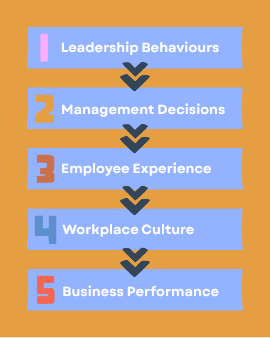
What this looked like for one organisation
The starting point
We recently worked with an organisation experiencing declining engagement, increasing staff turnover and growing frustration across several teams. From a leadership perspective, it initially looked like a communication issue.
Once we spent time with both leaders and employees, a different picture emerged. On paper, the organisation had many of the right foundations in place: clear values, a capable leadership team and managers who genuinely cared about their people.
However, employees described very different experiences depending on who they reported to:
Some managers held regular one-on-one meetings, gave clear feedback and addressed issues early.
Others avoided difficult conversations altogether.
Expectations varied from team to team.
Recognition looked different across the organisation.
In practice, people weren’t experiencing one culture. They were experiencing several.
What changed
Rather than introducing another engagement initiative, we worked with the leadership team to define clear behavioural expectations, strengthen leadership consistency and align their people practices with the culture they wanted to create. The change didn’t happen overnight, but over time employees began to experience the organisation more consistently. Leaders approached decisions, feedback and recognition with greater alignment, and people knew what to expect regardless of which team they worked in.
Culture is the Business
Sometimes culture is spoken about as though it's something HR owns.
We see it differently. Culture is simply the way business gets done.
It influences who gets promoted, how performance is managed, how recruitment decisions are made, how leaders communicate and how feedback is delivered. Every commercial decision either reinforces the culture an organisation wants to create or quietly moves it in another direction.
That's why we don't see culture as something to fix once engagement drops or turnover increases.
It's something that needs to be reinforced through everyday leadership and decision-making.This thinking sits behind our Culture Edit service. Before recommending solutions, we work alongside leaders to understand the behaviours, systems and leadership practices shaping the employee experience. From there, we help build practical frameworks that create consistency, strengthen leadership capability and support the culture the organisation wants to be known for.
One Question to Leave You With
If someone joined your organisation tomorrow, what would their first week teach them about your culture?
Not the culture described in your values statement, but the culture they would experience through:
the decisions they observe
the conversations they hear
the behaviours leaders recognise and reward.
That is where culture lives: in the everyday behaviours, systems and leadership practices that shape how people experience the organisation.
If your workplace culture feels different from the one you intended to create, it may not need another engagement initiative. It may need a closer look at what is being reinforced every day.If you’d like to understand where your culture is supporting your business, and where it may need attention, explore our Culture Editservice or contact HMNKND HR for a conversation.